It is argued between fans of media used for story telling whether or not fridge logic is inherently bad. I personally don't think it to be bad in all cases, but I do believe that certain circumstances can cause it to be so. That is why I've taken to recording my thoughts about a game just after I finish it, coming back later when it has stewed in my mind for awhile. Maybe I'll follow up on things I missed and complain about any story braking fridge logic at that time. For now, I'll just talk about a few things that stuck out to me.
Today's game is Crono Trigger, the first JRPG I have played through from beginning to end. I usually don't like JPRG's, but I liked this one a lot. I set a high bar for if a game was worth my time in retrospective or not, and this game effortlessly sailed over it with plenty of room to spare.
Showing posts with label reviews. Show all posts
Showing posts with label reviews. Show all posts
Saturday, January 19, 2013

Saturday, September 8, 2012
Mass Effect 3 - Extended Cut
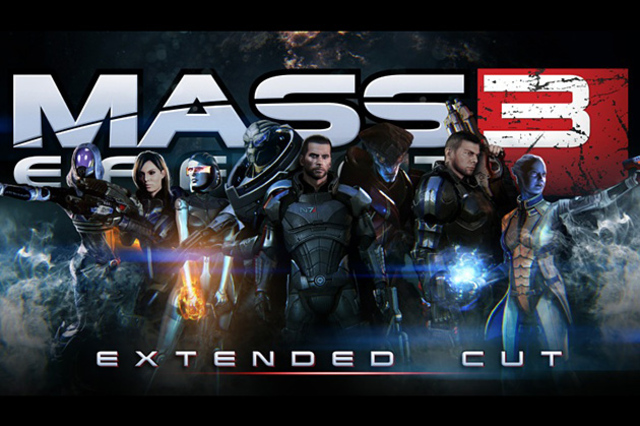
Awhile back when I did a from-the-hip-by-the-seat-of-my-pants review of Mass Effect 3, I spent an entire paragraph explaining how I wasn't going to talk about the ending. There is plenty of hate for it and some pretty awesome critiques of it that I can't touch. Then, along comes the extended cut. There is also a lot of good writing about the extended cut, but I have a few reasons to want to write about it myself. Before I get into those reasons(and before you hit the Read More button and blind yourself) I would like to warn you that the remainder of this post will obviously contain spoilers for the entire Mass Effect series and universe.
Saturday, May 12, 2012
Mass Effect 3 - System Sweep
Deciding how to start this post was hard. But what I arrived at was a rather clever piece of meta in my opinion.

Bla bla bla, Mass Effect 3, bla, bla bla, RPG, bla, lets just jump right in and sweep over all the little remaining systems I want to talk about for now before I start scoping out another game to discuss.
Bla bla bla, Mass Effect 3, bla, bla bla, RPG, bla, lets just jump right in and sweep over all the little remaining systems I want to talk about for now before I start scoping out another game to discuss.
Monday, May 7, 2012
Mass Effect 3 - Insert Vivid and Clever Simile About Cover Based Shooting here
After gabbing on about the story for an entire article, it's time to talk gameplay. The action gameplay specifically, as I'm saving the RPG like systems and other stuff for later articles.

The original Mass Effect had a cover system that was fiddly and awkward, but still held up well enough. The cover system in Mass Effect 2 was better, but still broken. So the third, final, and theoretically ultimate Mass Effect game should build on the knowledge gathered from the last two games and create an solid, effective cover system right? WRONG! Mass Effect 3 has the worst cover system of all three games.
The original Mass Effect had a cover system that was fiddly and awkward, but still held up well enough. The cover system in Mass Effect 2 was better, but still broken. So the third, final, and theoretically ultimate Mass Effect game should build on the knowledge gathered from the last two games and create an solid, effective cover system right? WRONG! Mass Effect 3 has the worst cover system of all three games.
Monday, April 30, 2012
Mass Effect 3 - The Dive In - Story
A little while ago I temporarily emerged from my sock drawer to play some mainstream AAA titles. The last part of this streak was all three games in the Mass Effect series. I actually timed things pretty well so that I ended up finishing ME2 just in time for the release of the third game which I also immediately played through. I thought about discussing it right away before all the hype and fan rage/defence settled down(not that it hasn't,) but that's not my style anyway. I'm not here to give consumer advice, and I'm not here to give everybody my two cents on the ending. I'm here to talk about interesting game design concepts and manifestations in games, and today I feel like Mass Effect 3.


Wednesday, March 7, 2012
Deus Ex Human Revolution - Conversation and Upgrades
And so we come to the third and final part of my amateur analysis and critique of many of the elements of Deus Ex: Human Revolution. Let's start out with a bit about the conversation mechanics in this game.

The conversation mechanics in this game are pretty solid, although a lot of the choices and conversations could better have been written in my opinion. I like that you can even install augmentations to aid you, allowing you to use pheromones and better read the person you're speaking to. This is just one of the many elements that help reinforce the idea that conversation is an important part of this game. Many parts of the game allow you to talk your way into places rather than shooting your way in, presenting what is possibly one of the best social engineering engines in a AAA game that has so many different systems. Yes, you can still accidentally select conversation options because you were skipping dialogue, which is something that is really starting to get on my nerves about most games. The people designing conversation engines should really do something about this.
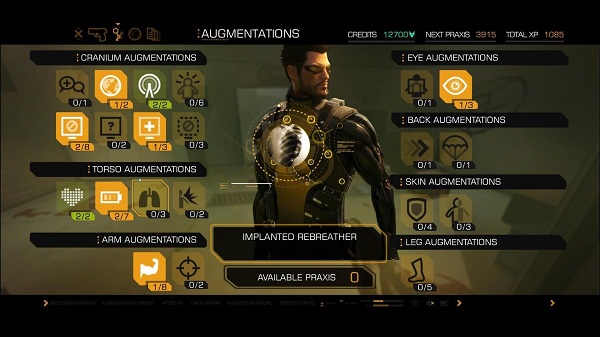
Of course, this wouldn't be a Deus Ex game without an augmentation based upgrade system.

The upgrades are fairly well balanced, each choice encouraging a certain play style. I'm pretty sure it's impossible to get enough XP to afford all the upgrades(I certainly didn't), meaning you WILL be making choices. The selection is varied and interesting as well, meaning on your next play-through you're quite likely to be interested in trying a totally different upgrade strategy.
And last but not least, we have the hacking mini-game which you'll have to face in order to access security devices like camera's, turret and robots. You can also use it to shut off alarms and other things, as well as read e-mails that reveal more of the story.

Naturally, the hacking is 100 percent unrealistic, but you're not here for a realistic game. I actually didn't enjoy the hacking that much since there was only a pinch of strategy involved, but I do think it was well designed. Based on my analysis of things I don't get but other people love, I'd say the hacking simulations in this game are pretty good. From a design perspective at least, they're will constructed.
At this point I guess I'm supposed to tell you whether or not you should try the game. Obviously I loved it, if for no other reason than that I love me some Cyberpunk here and there. The only reason I can think of that you wouldn't like it would be if you have excessive graphics demands for games. I think this game pulled off a beautiful aesthetic, so I apparently don't. I recommend you give it a go even if you aren't into Cyberpunk, just because this game rocks on so many other levels.
The inevitable question is also whether or not this game is better than the original. I must say that I loved the original, but I actually enjoyed this game more. Kill me if you must, but I think the previous game's development time was spent largely enough on overcoming technological limits as to hamper the other elements. Then it still ended up looking like the inside of a rusty metal coffee can.
--LazerBlade

The conversation mechanics in this game are pretty solid, although a lot of the choices and conversations could better have been written in my opinion. I like that you can even install augmentations to aid you, allowing you to use pheromones and better read the person you're speaking to. This is just one of the many elements that help reinforce the idea that conversation is an important part of this game. Many parts of the game allow you to talk your way into places rather than shooting your way in, presenting what is possibly one of the best social engineering engines in a AAA game that has so many different systems. Yes, you can still accidentally select conversation options because you were skipping dialogue, which is something that is really starting to get on my nerves about most games. The people designing conversation engines should really do something about this.
Of course, this wouldn't be a Deus Ex game without an augmentation based upgrade system.
The upgrades are fairly well balanced, each choice encouraging a certain play style. I'm pretty sure it's impossible to get enough XP to afford all the upgrades(I certainly didn't), meaning you WILL be making choices. The selection is varied and interesting as well, meaning on your next play-through you're quite likely to be interested in trying a totally different upgrade strategy.
And last but not least, we have the hacking mini-game which you'll have to face in order to access security devices like camera's, turret and robots. You can also use it to shut off alarms and other things, as well as read e-mails that reveal more of the story.

Naturally, the hacking is 100 percent unrealistic, but you're not here for a realistic game. I actually didn't enjoy the hacking that much since there was only a pinch of strategy involved, but I do think it was well designed. Based on my analysis of things I don't get but other people love, I'd say the hacking simulations in this game are pretty good. From a design perspective at least, they're will constructed.
At this point I guess I'm supposed to tell you whether or not you should try the game. Obviously I loved it, if for no other reason than that I love me some Cyberpunk here and there. The only reason I can think of that you wouldn't like it would be if you have excessive graphics demands for games. I think this game pulled off a beautiful aesthetic, so I apparently don't. I recommend you give it a go even if you aren't into Cyberpunk, just because this game rocks on so many other levels.
The inevitable question is also whether or not this game is better than the original. I must say that I loved the original, but I actually enjoyed this game more. Kill me if you must, but I think the previous game's development time was spent largely enough on overcoming technological limits as to hamper the other elements. Then it still ended up looking like the inside of a rusty metal coffee can.
--LazerBlade
Wednesday, February 29, 2012
Deus Ex Human Revolution - Stealth and Combat
A little while ago, I spent an entire post rambling about the story of this game. Lets see how much there is to say about the gameplay.

The main draw of the gameplay mechanics here is a simple yet powerful one. That is, simple to understand and think about. It's very difficult to actually pull off. There are a variety of different gameplay systems you'll be interacting with throughout the game, and all of them mesh and flow together smoothly. For example, I was stealthing around and hiding in ventilation shafts one moment, hacking into computers the next, and then engaged in a gun battle another moment later. Each of these elements play differently, and yet they all fit together to deliver a single, unified game. Let's look at them independently.

The first thing I noted right off the bat was the stealth. It rocks. Like a ton. Like, really. It ROCKS. I was originally quite pessimistic when I learned there was a cover system, but that went away quick when I noticed that I was applying it mostly to stealth. Cover based shooting is still there, but I'll get to that a little later. The main thing now is the stealth. I was originally expecting a watered down, simplified, and immensely boring stealth system. I was pleasantly mistaken. The stealth system is complex, interesting, and easy to start using. It balances quite well as something that takes a only minute to learn, but much practice to master.
Your footsteps make sound, guns without a silencer make sound, sound gives your position and presence away. Letting cameras or guards find bodies will give your presence away. Crawling makes your movement silent. Sound doesn't travel nearly as far past closed doors. The stealth system here is really a good one. This is especially because it mixes so smoothly with the action/battle system.

The action really doesn't stick out here in many ways. In the standard FPS mode, it's a standard FPS. You have guns and they go boom. I actually noticed that the weapon system was watered down in this sequel. In the original Deus Ex, there were different kinds of ammo for different kinds of guns. For example, the crossbow could be loaded with poisonous or tranquilizer darts. In this game, all of that goes away. Certain weapons kill, others don't.
The weapons aren't as intersting and varied as the original Deus Ex, but they're more fun than what you'll see in a cliche' AAA "realistic" shooter. There are actually some variations on the usual combination of the same FPS guns with different names. The P.E.P.S, EMP grenade, mine, R.D.E.D, tranquilizer rifle, and stun gun are all fun and interesting, although not especially. Of course, this game does have the usual canon of weapons(pun intended). There is a shotgun, pistol, assault rifle, and rocket launcher.
The cover system in this game is typical. It works, but it really doesn't stick out. I'm honestly getting bored of cover shooters, and I would have tagged the cover system as a bad thing if it didn't mix in and make the stealth more interesting. For all practical purposes, the combat system is cliche' and unimpressive. Fortunately it's not the forced center of the game. Since this game has so many elements, a functional combat system is just the icing on the cake.
Mainly of note when it comes to this games combat is that it ISN'T your cliche' "realistic" shooter. It's true that it leans a bit in that direction, but it doesn't lean far enough to bore me. This game takes the shooter thing and makes it a smoothly integrated, non-central(unless you want it to be) feature.
Wowzers. This is turning into my longest game review ever. There really is plenty to say about this game. Come next time, I'll talk about the mini-games and conversation.
--LazerBlade
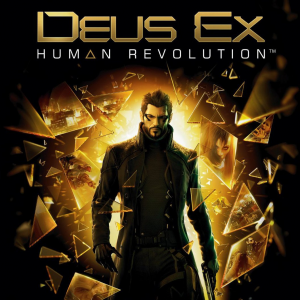
The main draw of the gameplay mechanics here is a simple yet powerful one. That is, simple to understand and think about. It's very difficult to actually pull off. There are a variety of different gameplay systems you'll be interacting with throughout the game, and all of them mesh and flow together smoothly. For example, I was stealthing around and hiding in ventilation shafts one moment, hacking into computers the next, and then engaged in a gun battle another moment later. Each of these elements play differently, and yet they all fit together to deliver a single, unified game. Let's look at them independently.

The first thing I noted right off the bat was the stealth. It rocks. Like a ton. Like, really. It ROCKS. I was originally quite pessimistic when I learned there was a cover system, but that went away quick when I noticed that I was applying it mostly to stealth. Cover based shooting is still there, but I'll get to that a little later. The main thing now is the stealth. I was originally expecting a watered down, simplified, and immensely boring stealth system. I was pleasantly mistaken. The stealth system is complex, interesting, and easy to start using. It balances quite well as something that takes a only minute to learn, but much practice to master.
Your footsteps make sound, guns without a silencer make sound, sound gives your position and presence away. Letting cameras or guards find bodies will give your presence away. Crawling makes your movement silent. Sound doesn't travel nearly as far past closed doors. The stealth system here is really a good one. This is especially because it mixes so smoothly with the action/battle system.

The action really doesn't stick out here in many ways. In the standard FPS mode, it's a standard FPS. You have guns and they go boom. I actually noticed that the weapon system was watered down in this sequel. In the original Deus Ex, there were different kinds of ammo for different kinds of guns. For example, the crossbow could be loaded with poisonous or tranquilizer darts. In this game, all of that goes away. Certain weapons kill, others don't.
The weapons aren't as intersting and varied as the original Deus Ex, but they're more fun than what you'll see in a cliche' AAA "realistic" shooter. There are actually some variations on the usual combination of the same FPS guns with different names. The P.E.P.S, EMP grenade, mine, R.D.E.D, tranquilizer rifle, and stun gun are all fun and interesting, although not especially. Of course, this game does have the usual canon of weapons(pun intended). There is a shotgun, pistol, assault rifle, and rocket launcher.
The cover system in this game is typical. It works, but it really doesn't stick out. I'm honestly getting bored of cover shooters, and I would have tagged the cover system as a bad thing if it didn't mix in and make the stealth more interesting. For all practical purposes, the combat system is cliche' and unimpressive. Fortunately it's not the forced center of the game. Since this game has so many elements, a functional combat system is just the icing on the cake.
Mainly of note when it comes to this games combat is that it ISN'T your cliche' "realistic" shooter. It's true that it leans a bit in that direction, but it doesn't lean far enough to bore me. This game takes the shooter thing and makes it a smoothly integrated, non-central(unless you want it to be) feature.
Wowzers. This is turning into my longest game review ever. There really is plenty to say about this game. Come next time, I'll talk about the mini-games and conversation.
--LazerBlade
Wednesday, February 22, 2012
Deus Ex: Human Revolution - Story and Choice
There is a lot to say about this game. It's so full of good content, yet flawed in enough places to rag on it a bit. This might stretch out over 2-4 posts. What can I say? There hasn't been a good Cyberpunk game in awhile.

I'm going to jump into the story of this game first. One choice I loved, was when they had about half of the intro be in gameplay. Of course, I hated the first-person invisible train track bit, but it didn't last long. Anyway, you play Adam Jenson who works as security chief at Sarif Industries. Megan Reed (your wife? Girlfriend? I dunno.) works at Sarif as well, developing new human augmentation technology and planning on presenting about it at a soon to occur UN meeting.
The security system goes off, and Sarif(your boss) sends you down to the location of the breach to see what's going on. You see a bunch of heavily augmented mercenary dudes killing all the scientist and destroying all the research. You look for Megan, who is in that very section of the building, and probably in danger. Then some big mercenary dude shows up, punches a hole in your stomach, throws you through a wall, chokes you half to death, and then shoots you in the face.
The evil mercenary dudes leave you for dead. Of course, in game intros where the player gets shot in the face, it's never fatal. Sarif pushes what's left of your body to the limit, installing as many of the most advanced cyebrnetic augmentations as possible. After a six month recovery period, you come back to work. And so begins an extremely cyberpunk story where you start by setting off looking for answers about this random massacre where Megan and all her fellow scientists were burned beyond recognition along with their research.
As far as introductions go, this games is not the most creative. However, it does an excellent job of giving the context, setting the atmosphere, and actually immersing the player. The best touch was when you went through the labs looking for Megan before you got augmented. In FPS games, you're probably used to being a super-soldier who can jump 2 meters high and take several bullets before you have to recharge your health. In the beginning of this game however, you play a normal, un-augmented person who is weak compared to the augmented mercs you're up against. This is in contrast to you once you've been augmented. You experience the transformation Adam goes through first hand.

I have to talk about the choice and the endings. First off, your choices have no effect on the plot of the game until the very end. When I got to the end, I had 4 buttons to push, each of which represented a different choice. This ruined everything for me. I knew I was essentially just selecting from 4 different ending cutscenes, so I chose each one and watched each ending. This is NOT how player choice should work. This is worsened by the fact that the only selection that didn't paint you as a liar or someone who gives a slant on the truth painted you as mentally unstable.
On the gameplay choices side however, this game is almost stainless. Almost. We've probably all heard reviewers raging on this game for the mandatory boss fights, so I won't spend your time criticizing something which has already been criticized by everybody else. It was a stupid, bad decision. All the other choices work pretty solidly though. The game does an excellent job holding up a number of different ways to handle each situation, each one having different consequences and outcomes. The game will be worth playing through multiple times for most, just because of all the different ways things can be done.
Another good aspect of the game's story is non-vilification of the player. Many games will impose a set of morals on you, judging your choices as either good or evil. In this game however, the moral dilemma is spun to match your perspective.
That's another thing. When I started this game, I was of the opinion that there was no dilemma. This game convinced me otherwise, although leaving my perspective the same. I'm personally pro human augmentation and enhancements. IRL.
The story really isn't air tight, it's just a few levels above what we've come to expect. I think the story here is a step in the right direction. I would definitely like to see more games with stories like these.
Wow. I spent this entire post just talking a little bit about the story. This serves to exemplify how much there is to say about this game. Assuming the reason I go on isn't just that I'm obsessed with Cyberpunk.
--LazerBlade

I'm going to jump into the story of this game first. One choice I loved, was when they had about half of the intro be in gameplay. Of course, I hated the first-person invisible train track bit, but it didn't last long. Anyway, you play Adam Jenson who works as security chief at Sarif Industries. Megan Reed (your wife? Girlfriend? I dunno.) works at Sarif as well, developing new human augmentation technology and planning on presenting about it at a soon to occur UN meeting.
The security system goes off, and Sarif(your boss) sends you down to the location of the breach to see what's going on. You see a bunch of heavily augmented mercenary dudes killing all the scientist and destroying all the research. You look for Megan, who is in that very section of the building, and probably in danger. Then some big mercenary dude shows up, punches a hole in your stomach, throws you through a wall, chokes you half to death, and then shoots you in the face.
The evil mercenary dudes leave you for dead. Of course, in game intros where the player gets shot in the face, it's never fatal. Sarif pushes what's left of your body to the limit, installing as many of the most advanced cyebrnetic augmentations as possible. After a six month recovery period, you come back to work. And so begins an extremely cyberpunk story where you start by setting off looking for answers about this random massacre where Megan and all her fellow scientists were burned beyond recognition along with their research.
As far as introductions go, this games is not the most creative. However, it does an excellent job of giving the context, setting the atmosphere, and actually immersing the player. The best touch was when you went through the labs looking for Megan before you got augmented. In FPS games, you're probably used to being a super-soldier who can jump 2 meters high and take several bullets before you have to recharge your health. In the beginning of this game however, you play a normal, un-augmented person who is weak compared to the augmented mercs you're up against. This is in contrast to you once you've been augmented. You experience the transformation Adam goes through first hand.

I have to talk about the choice and the endings. First off, your choices have no effect on the plot of the game until the very end. When I got to the end, I had 4 buttons to push, each of which represented a different choice. This ruined everything for me. I knew I was essentially just selecting from 4 different ending cutscenes, so I chose each one and watched each ending. This is NOT how player choice should work. This is worsened by the fact that the only selection that didn't paint you as a liar or someone who gives a slant on the truth painted you as mentally unstable.
On the gameplay choices side however, this game is almost stainless. Almost. We've probably all heard reviewers raging on this game for the mandatory boss fights, so I won't spend your time criticizing something which has already been criticized by everybody else. It was a stupid, bad decision. All the other choices work pretty solidly though. The game does an excellent job holding up a number of different ways to handle each situation, each one having different consequences and outcomes. The game will be worth playing through multiple times for most, just because of all the different ways things can be done.
Another good aspect of the game's story is non-vilification of the player. Many games will impose a set of morals on you, judging your choices as either good or evil. In this game however, the moral dilemma is spun to match your perspective.
That's another thing. When I started this game, I was of the opinion that there was no dilemma. This game convinced me otherwise, although leaving my perspective the same. I'm personally pro human augmentation and enhancements. IRL.
The story really isn't air tight, it's just a few levels above what we've come to expect. I think the story here is a step in the right direction. I would definitely like to see more games with stories like these.
Wow. I spent this entire post just talking a little bit about the story. This serves to exemplify how much there is to say about this game. Assuming the reason I go on isn't just that I'm obsessed with Cyberpunk.
--LazerBlade
Thursday, January 19, 2012
Crysis 2 - Part 2
After a break, I have returned to complete my review of Crysis 2. Let's start out with the visuals.
Crysis 2 has pretty visuals. There. I mean, that's kind of what we've come to expect from CryTek isn't it? At one point, I thought I was watching a pre-rendered cutscene. I thought my character must be pretty stupid to just stand there. Then I noticed that it was in real time, and I had full control. So yes, the visuals are quite good.

Gameplay-wise, this game feels a little different from the original Crysis. The original Crysis seemed to interact in a way to show how awesome the nanosuit was. In Crysis 2, everybody spends at least five minutes talking about how awesome it is, but it doesn't feel the same. Since the feeling that the suit you're in is awesome has already been conveyed in the first game, the second game makes it feel more like you're actually in the suit.
I like the addition of a visor to replace the binoculars and use for tactical analysis. It's one of those things that makes the suit seem more like a battlefield companion. It's kind of like the new ability to kick cars into the air. They're both things I should have been able to do in the first game. I was always thinking to myself "If I can pick this dude up and throw him through a house hard enough to knock it over, why can't I throw some of these cars around?" That, and throwing cars adds to the awesome macho dude feeling.
Another change to the suit is in power and energy management. You can now use two superpowers at a time, since your suit automatically uses strength to strike and for super-jumps. Of course, using multiple powers will drain energy faster, but it's still a very useful tactical option. Armor mode now drains energy when in use whether or not you're taking damage. If you upgrade that feature of the suit though, it will drain very slowly unless you're taking damage or using a different superpower.
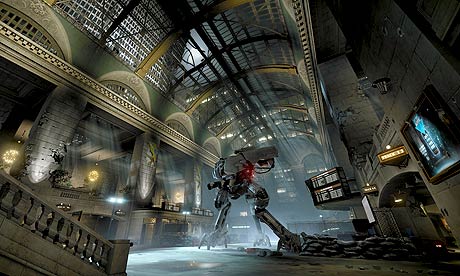
I have to admit that the enemies seem a bit repetitive. I'm not violent to humans IRL, so I was avoiding killing people at all costs(and to see just how open-ended the game really was.) Throughout the game, only 1 person has to be killed by your character. I was enjoying blasting my way through swarms of aliens, but I got sick of it fast enough that I just started cloaking myself to sneak past them all. There are too few enemy types spread out over too much world-space is what I think.
Let's talk about QTE's, or for those of you new to this, quick time events. It's that thing where games play a cutscene and tell you which buttons to push and when to make your character do certain things(usually avoiding death.) Crysis 2 had QTE's, and they're just as bad as ever. Worse is the fact that they seem tacked on like the designers were going through a check-list of features. They seemed out of place in an otherwise glittering work.
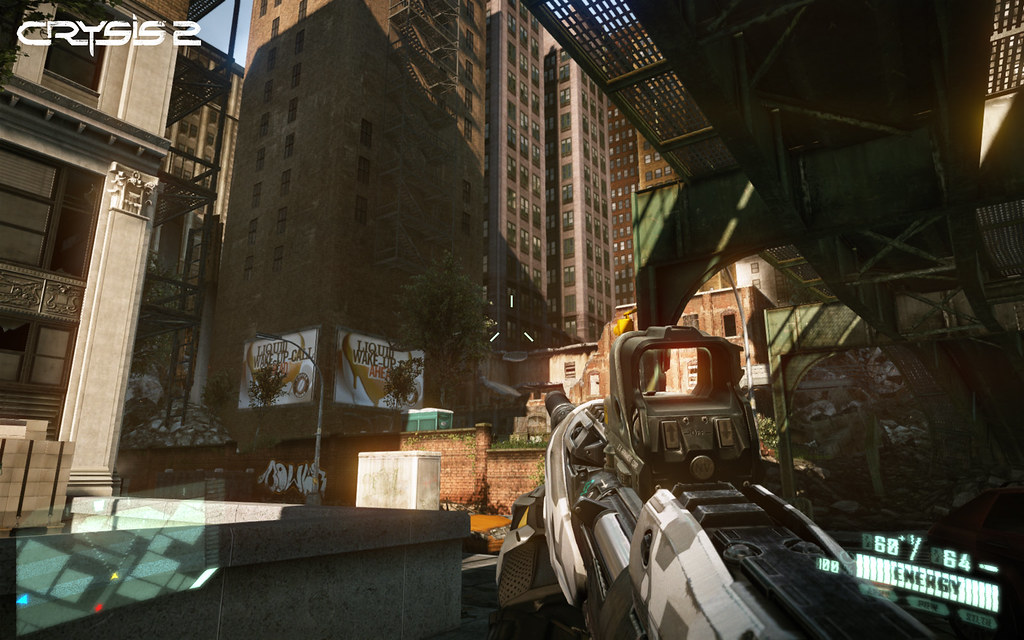
While there's only a few interesting weapons, which still fail to be extremely unique, the game does the best cover based shooting I've seen anywhere. That's right, coming from someone who has played whole games dedicated to cover shooting like Mass Effect 2. The problem with ME2 is that cover shooting was all it had going for it. Crysis 2 has a cover system that seamlessly integrates with the FPS-circle-strafing-stealth-ambushing elements of the game.
Rather than gluing yourself to random objects the level designers chose as "cover," Crysis 2 takes a different approach. Simply get real close to almost anything, and you can hold down the right mouse button and move it around to lean. You can lean up, down, left, right, etc. It doesn't matter if you're crouched, or on your feet. It mixes so very well with the other elements, requiring a mix of cover based defence skills, raw speedy action skills, strategic skills, and stealth skills to do your best at the game.
One last thing to mention about Crysis 2 is something that I also found to also exist in the original Crysis. I'm not sure if it's good, bad, accidental, intentional, black, white or anything. I just know it exists. Basically, all enemies take from about 1-5 seconds to recover after receiving an attack. This can lead to scenarios like the end, where I beat the boss enemies to death one at a time with the blunt end of my machine gun. See, you're speedy enough to do a melee in about 0.75 seconds. This gives you the speed advantage you need. Just run up to them and start smacking. This also made several parts of Crysis 1 a lot easier than I thought they were supposed to be. There's a super-climatic part of the game where you have to blast some semi-boss dudes, but it seemed easier than it was supposed to be for this same reason. Just line the four of them up and go down the line shooting them one at a time and they'll all drop without getting in a shot.
So, that's Crysis 2. It's a game with good writing, pretty pictures, and fun gameplay. The hard part here is deciding whether or not it gets my award for being one of the rare sequels which is better than the original. System Shock 2 is the ONLY work on this list to date, game or other medium. Comparing these two is hard. See, Crysis 2 has a better story. However, Crysis 1 feels more free and open, not just from a sandbox point of view. You could even holster all your weapons and break things up Chuck Norris style if you felt like it. Crysis 1 also had some pretty sweet moments that Crysis 2 didn't really match. Then on the other hand, Crysis 2 feels more complete and polished.
All in all, I think Crysis 2 failed to capture the feeling of the original and do something new with it. I'm not saying Crysis 2 is worse than the original, or bad by any stretch of the imagination. You should play both. I'm just saying that Crysis 2 doesn't really seem better than the first to me.
Final Score: 7.5
Why this score?
--LazerBlade
Wednesday, January 11, 2012
Crysis 2 Part 1
I recently finished Crysis 2. Since I had finished the first Crysis less than two months ago, I had very high expectations for it's sequel, especially after having heard so much about how it was great. I started Crysis in doubt, with my nitpicking and cynical eye. I left feeling awesome, and wanting more. This caused the decision to start Crysis 2 with high expectations, thus making sure I wasn't letting it by just because is was better than I thought it would be. That didn't work though, because it was STILL better than I thought it would be.

Crysis 2 touts good gameplay, spiffy visuals, and clever story. I'm going to start with the story since the point of a game is (supposed to be) to tell a story via player experience.
You start the game on board a submarine full of dudes sent to New York to back up Prophet, the nanosuit team commander from the first game. Things go wrong and the sub ends up sinking due to alien invasion(which is apparently why you were sent to New York). You wash up on shore where Prophet drags your semi-living body into some park and sticks the suit on you. He tells you to finish what he started, that you're the "last hope," and to find some dude named Nathan Guold. Apparently there is some kind of alien epidemic spreading through the city as well, so the city is in ruins for more than one reason. You don't find out that the entire military is after you until you run into it, at which point the game starts.
The story in Crysis 2 is actually a lot better than what we've come to expect from video games these days. I kept mis-predicting the plot based on the usual method of assuming poor pacing and cliche' characters/plot twists. Almost everything was clever and original, as well as being well told and presented. I'm having to really try in order avoid spoilers, but that's a price worth paying.
The game even managed to pull a fast one on me and use an un-original plot twist, but in such a way that I didn't see it coming. I've seen that plot twist at least twice in other stories, and both times I saw it coming. This time, I didn't. The writers of Crysis 2 were a good deal better than the writers that somehow get hired for most games.

Let's talk about the characters a bit. I'm going to name one of them. Tara Strickland. This character, and her contribution to the plot are where the weak spots of the story show through. She was cliche', predictable, boring, and just plain stupid. It was hard for me to observe this character with a straight face. Seeing such a hollow and flat character floating in a sea of deep and interesting characters makes me think the writers did it on purpose for laughs.
The main reason this character borked me was because I knew they could have done better. I saw Tara as an opportunity for an awesome character when she was introduced. It came as a let down when I learned that these writers just threw her in there to meet the minimum requirement for one sassy chick who knows better per game. I have nothing against sassy female characters, even ones who know better than everybody else. It's when that's ALL they are that I roll my eyes.
Whew. Got that rant out of my system. I'd normally go on to gameplay and visuals now, but this post is starting to stretch out. Better make it a two-parter. Stay tuned...
--LazerBlade

Crysis 2 touts good gameplay, spiffy visuals, and clever story. I'm going to start with the story since the point of a game is (supposed to be) to tell a story via player experience.
You start the game on board a submarine full of dudes sent to New York to back up Prophet, the nanosuit team commander from the first game. Things go wrong and the sub ends up sinking due to alien invasion(which is apparently why you were sent to New York). You wash up on shore where Prophet drags your semi-living body into some park and sticks the suit on you. He tells you to finish what he started, that you're the "last hope," and to find some dude named Nathan Guold. Apparently there is some kind of alien epidemic spreading through the city as well, so the city is in ruins for more than one reason. You don't find out that the entire military is after you until you run into it, at which point the game starts.
The story in Crysis 2 is actually a lot better than what we've come to expect from video games these days. I kept mis-predicting the plot based on the usual method of assuming poor pacing and cliche' characters/plot twists. Almost everything was clever and original, as well as being well told and presented. I'm having to really try in order avoid spoilers, but that's a price worth paying.
The game even managed to pull a fast one on me and use an un-original plot twist, but in such a way that I didn't see it coming. I've seen that plot twist at least twice in other stories, and both times I saw it coming. This time, I didn't. The writers of Crysis 2 were a good deal better than the writers that somehow get hired for most games.
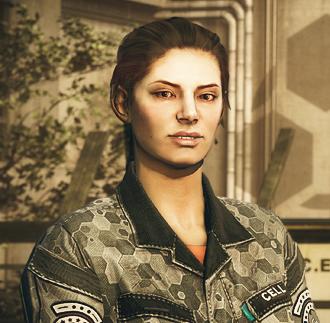
Let's talk about the characters a bit. I'm going to name one of them. Tara Strickland. This character, and her contribution to the plot are where the weak spots of the story show through. She was cliche', predictable, boring, and just plain stupid. It was hard for me to observe this character with a straight face. Seeing such a hollow and flat character floating in a sea of deep and interesting characters makes me think the writers did it on purpose for laughs.
The main reason this character borked me was because I knew they could have done better. I saw Tara as an opportunity for an awesome character when she was introduced. It came as a let down when I learned that these writers just threw her in there to meet the minimum requirement for one sassy chick who knows better per game. I have nothing against sassy female characters, even ones who know better than everybody else. It's when that's ALL they are that I roll my eyes.
Whew. Got that rant out of my system. I'd normally go on to gameplay and visuals now, but this post is starting to stretch out. Better make it a two-parter. Stay tuned...
--LazerBlade
Saturday, January 7, 2012
2011 retrospect
I was going to do a write up about site stats. Then I decided to turn it into a 2011 retrospective. Then I noticed that this will be the 100th post on this blog, posted on my birthday. Crazy how things work out huh?
So what did I accomplish this year? I finished a 3D screensaver, reviewed a number of games, started a webcomic, created two music albums, started a webshow and finished the first season, moved to this new blog, and made quite a bit of headway in a new game project.
Now the stats are interesting. Things started pretty slow, with a normal build. Then, two months ago, traffic started climbing like crazy. I have about 1000 views a month now, and still climbing. The one thing that orks me, is why I have so many silent viewers. I get comments from time to time, but yeesh. Talk about the silent majority...
Now I have to look back and see what I learned I guess. After all, what is age, if not a measure of experience? No, I don't make resolutions. I'm already more awesome than the average person the way I am.
So, I learned many things. The first thing I learned is not to start a project without being willing to commit serious amounts of time to it. Something that just takes an hour a day is a huge investment. Secondly, try to make very specific goals about the end product of any project at the beginning, to avoid confusion later on. Third, try to be realistic about what projects you choose to start. It's okay to be ambitious, but make sure you have the time, skills, and resources to complete your project before you start. It seems generally best to choose a project that's just a bit out of your comfort zone. Something where you'll have to learn new things, but something you can still finish. Fourth, school should NOT be taken for granted. It's not safe to assume that your school will take care of itself while you work on something else. Last, under promise and over deliver. I've never been 100% accurate on how much time or other resources it would take to complete a project. It's much better to assume it will take more than you think. That way if it does, you''re ready for it, and if not, you just come out ahead of schedule(which is a good thing.)
I'm sure I've learned plenty more, but these five seem to stick out the most. Anything else I need to mention that's important... Oh yeah. Start writing blog posts early so they don't have to cut o-
--LazerBlade
So what did I accomplish this year? I finished a 3D screensaver, reviewed a number of games, started a webcomic, created two music albums, started a webshow and finished the first season, moved to this new blog, and made quite a bit of headway in a new game project.
Now the stats are interesting. Things started pretty slow, with a normal build. Then, two months ago, traffic started climbing like crazy. I have about 1000 views a month now, and still climbing. The one thing that orks me, is why I have so many silent viewers. I get comments from time to time, but yeesh. Talk about the silent majority...
Now I have to look back and see what I learned I guess. After all, what is age, if not a measure of experience? No, I don't make resolutions. I'm already more awesome than the average person the way I am.
So, I learned many things. The first thing I learned is not to start a project without being willing to commit serious amounts of time to it. Something that just takes an hour a day is a huge investment. Secondly, try to make very specific goals about the end product of any project at the beginning, to avoid confusion later on. Third, try to be realistic about what projects you choose to start. It's okay to be ambitious, but make sure you have the time, skills, and resources to complete your project before you start. It seems generally best to choose a project that's just a bit out of your comfort zone. Something where you'll have to learn new things, but something you can still finish. Fourth, school should NOT be taken for granted. It's not safe to assume that your school will take care of itself while you work on something else. Last, under promise and over deliver. I've never been 100% accurate on how much time or other resources it would take to complete a project. It's much better to assume it will take more than you think. That way if it does, you''re ready for it, and if not, you just come out ahead of schedule(which is a good thing.)
I'm sure I've learned plenty more, but these five seem to stick out the most. Anything else I need to mention that's important... Oh yeah. Start writing blog posts early so they don't have to cut o-
--LazerBlade
Tuesday, November 22, 2011
Crysis
Odd as it may seem, I've only recently picked up Crysis. I won't bother making excuses, but I will give you a review. Note that I've spent probably only around ten hours on this thing so far. A plus here is that there are less spoilers I could reveal even if I wanted to. So let us begin...

Crysis is a sci-fi FPS adventure game developed by CryTek and released in 2007. The official "trial by fire" for gaming rigs, Crysis has made a significant name for itself. Unusual for a game 4 years old, it still pushes the limits of modern PC's at the highest detail. Naturally, it was still no match for my uber-rig, but it did put up a fight.
Touted elements include story, open-ended objectives, interesting mechanics, spiffy environments, and pretty pictures. Don't bork me for spending the rest of this review explaining how it kind of does these things, but halfheartedly.
Crysis at it's core is a cliche action FPS with the usual re-charging health and hiding behind things. I'm thankful that it's not the usual cover-based fare, but you had better hide behind things yourself if you expect to survive. It feels like they started out with a shooter where the player could use superpowers, and then decided to strap a bunch of other things on.
Story goes that some random island which archaeologists are excavating is taken over by Koreans. The transmissions from the island go silent, so you and a bunch of other dudes wearing funky "nanosuits" drop onto the island in the middle of the night. These nanosuits bestow superpowers on whomever happens to be wearing them at the time. You get separated during the drop, and get pretty quickly picked off until there's only half of you left. The story is actually interesting and convincing, but doesn't really make up a big part of the game. In places you can feel that it's just an excuse for you to do more shooting.

The gameplay itself is pretty solid. There were some awesome moments. Allow me to transcribe my thoughts during one:
"The signal says the hostage is in this building. Better switch to strength mode and jump up on top of it. Hack! The dude on top of the building is firing a machine gun at me! Armor mode to absorb the bullets. Speed mode as soon as I hit the ground so that I can run behind a corner. I know, I can switch to cloak mode and sneak up behind him. Then I can smack him in the face with the chicken I've been carrying around."
Unfortunately, these are spread out around "Go kill 400 dudes, it's going to be impossible if you want to sneak by, because that wasn't the way the game designers meant it" moments. It does go between a shooter and a stealth game pretty smoothly, although I would have preferred more choice in when you use stealth and when you don't.
I'm glad that the cutscenes are in first person. It kind of reminds me of Half Life. A lot of things about the game remind me of Half Life I guess. It's still its own thing though, which I also like.
The island setting is interesting, and I haven't got bored of it yet because the day/night cycle keeps changing the aesthetic. I'm sure the setting eventually changes, and it had better. I think this island setting will get boring sooner or later.
While this game has creative elements in many places, the weapons are all cliche. You get usual mixes of sniper rifles, machine guns, shotguns, grenades, and rocket launchers. Not to mention that the game still does that thing I hate where you can only carry a few weapons with you. I know the argument here is that it's more realistic, but if I wanted a realistic experience I would just stay in real life.
I'd love to write more about this game at some point, but I hope this review can give you a good peak. The verdict for me is that it's a game with many good elements, but a lack of depth and lack of concentration on any of the good elements takes away from the experience. I guess that the main problem here is that there really isn't that much to the game apart from it's cliche first person shooting.
Final Score: 7.5
(why this score?)
--LazerBlade

Crysis is a sci-fi FPS adventure game developed by CryTek and released in 2007. The official "trial by fire" for gaming rigs, Crysis has made a significant name for itself. Unusual for a game 4 years old, it still pushes the limits of modern PC's at the highest detail. Naturally, it was still no match for my uber-rig, but it did put up a fight.
Touted elements include story, open-ended objectives, interesting mechanics, spiffy environments, and pretty pictures. Don't bork me for spending the rest of this review explaining how it kind of does these things, but halfheartedly.
Crysis at it's core is a cliche action FPS with the usual re-charging health and hiding behind things. I'm thankful that it's not the usual cover-based fare, but you had better hide behind things yourself if you expect to survive. It feels like they started out with a shooter where the player could use superpowers, and then decided to strap a bunch of other things on.
Story goes that some random island which archaeologists are excavating is taken over by Koreans. The transmissions from the island go silent, so you and a bunch of other dudes wearing funky "nanosuits" drop onto the island in the middle of the night. These nanosuits bestow superpowers on whomever happens to be wearing them at the time. You get separated during the drop, and get pretty quickly picked off until there's only half of you left. The story is actually interesting and convincing, but doesn't really make up a big part of the game. In places you can feel that it's just an excuse for you to do more shooting.

The gameplay itself is pretty solid. There were some awesome moments. Allow me to transcribe my thoughts during one:
"The signal says the hostage is in this building. Better switch to strength mode and jump up on top of it. Hack! The dude on top of the building is firing a machine gun at me! Armor mode to absorb the bullets. Speed mode as soon as I hit the ground so that I can run behind a corner. I know, I can switch to cloak mode and sneak up behind him. Then I can smack him in the face with the chicken I've been carrying around."
Unfortunately, these are spread out around "Go kill 400 dudes, it's going to be impossible if you want to sneak by, because that wasn't the way the game designers meant it" moments. It does go between a shooter and a stealth game pretty smoothly, although I would have preferred more choice in when you use stealth and when you don't.
I'm glad that the cutscenes are in first person. It kind of reminds me of Half Life. A lot of things about the game remind me of Half Life I guess. It's still its own thing though, which I also like.
The island setting is interesting, and I haven't got bored of it yet because the day/night cycle keeps changing the aesthetic. I'm sure the setting eventually changes, and it had better. I think this island setting will get boring sooner or later.
While this game has creative elements in many places, the weapons are all cliche. You get usual mixes of sniper rifles, machine guns, shotguns, grenades, and rocket launchers. Not to mention that the game still does that thing I hate where you can only carry a few weapons with you. I know the argument here is that it's more realistic, but if I wanted a realistic experience I would just stay in real life.
I'd love to write more about this game at some point, but I hope this review can give you a good peak. The verdict for me is that it's a game with many good elements, but a lack of depth and lack of concentration on any of the good elements takes away from the experience. I guess that the main problem here is that there really isn't that much to the game apart from it's cliche first person shooting.
Final Score: 7.5
(why this score?)
--LazerBlade
Saturday, October 1, 2011
Game Review: "Invaders: Corruption"
Today I review this game:

I was planning on talking about the awesome GridWars game, and then ranting on Microsoft-erm "Bizarre creations" for having it taken down. Unfortunately I remembered my intention to review a game I truly hate. Plus I couldn't get it running on Linux again. Which stank.
So instead, you all get to watch me ranting about something else. In this case, I switched out for a different arena shooter, Invaders Corruption. And while I don't really "hate" this game, you can safely assume this review isn't going to be positive.
Invaders Corruption is an overhead 2D arena shooter made by Manuel van Dyck. The thesis of the game is that enemies, arena's, the player, and even gameplay can be generated in a procedural manner based on a core-seed. This hands us a really interesting game, with pretty visuals, which ultimately ends up being somewhat annoying.
Maybe I've been spoiled by really good arena shooters like GridWars, but this game seems to prove that there are no inherently good genre's. You see, this genre usually has a huge edge. The reason is that the learning curve is about 15 minutes, you can enjoy a game in 10 minutes a day, and you can also go all out and spend hours and hours before reaching mastery. This game lacks this crucial element.
Now if so much is really generated, how can I claim this game to have so little depth? The reason is that while most of the graphics are procedural, VERY little of the gameplay will change. This is even true when plugging in all kinds of core-seeds.

Most arena shooters are 1-hit-1-kill games. You get bombs to help protect you, a few extra lives to help you last longer, and enemies are about the size of your ship. This game is 1-hit-1-kill, but you get only 1 life, and start with one bomb. Your ship is almost always far too big compared to the enemies, requiring you to try core-seed after core-seed to get close to decent proportions. This is worsened by the fact that your ship usually has too much inertia, as well as wall bounce.
Because of these things, I very seldom die because I couldn't handle it. I almost always die because I didn't see that tiny enemy, or my ship bounced off a wall too hard, or getting the ship to go where I want it doesn't always work. Then the over-punishment which comes from having only 1 life sets in.
So yes, this is a popular game. While this game isn't that fun to play, especially for very long, it is pretty interesting. I recommend you give it a try, regardless of your tastes. It's free, and runs in WINE so you have no excuse.
Final score: 6
(why this score?)
--LazerBlade

I was planning on talking about the awesome GridWars game, and then ranting on Microsoft-erm "Bizarre creations" for having it taken down. Unfortunately I remembered my intention to review a game I truly hate. Plus I couldn't get it running on Linux again. Which stank.
So instead, you all get to watch me ranting about something else. In this case, I switched out for a different arena shooter, Invaders Corruption. And while I don't really "hate" this game, you can safely assume this review isn't going to be positive.
Invaders Corruption is an overhead 2D arena shooter made by Manuel van Dyck. The thesis of the game is that enemies, arena's, the player, and even gameplay can be generated in a procedural manner based on a core-seed. This hands us a really interesting game, with pretty visuals, which ultimately ends up being somewhat annoying.
Maybe I've been spoiled by really good arena shooters like GridWars, but this game seems to prove that there are no inherently good genre's. You see, this genre usually has a huge edge. The reason is that the learning curve is about 15 minutes, you can enjoy a game in 10 minutes a day, and you can also go all out and spend hours and hours before reaching mastery. This game lacks this crucial element.
Now if so much is really generated, how can I claim this game to have so little depth? The reason is that while most of the graphics are procedural, VERY little of the gameplay will change. This is even true when plugging in all kinds of core-seeds.

Most arena shooters are 1-hit-1-kill games. You get bombs to help protect you, a few extra lives to help you last longer, and enemies are about the size of your ship. This game is 1-hit-1-kill, but you get only 1 life, and start with one bomb. Your ship is almost always far too big compared to the enemies, requiring you to try core-seed after core-seed to get close to decent proportions. This is worsened by the fact that your ship usually has too much inertia, as well as wall bounce.
Because of these things, I very seldom die because I couldn't handle it. I almost always die because I didn't see that tiny enemy, or my ship bounced off a wall too hard, or getting the ship to go where I want it doesn't always work. Then the over-punishment which comes from having only 1 life sets in.
So yes, this is a popular game. While this game isn't that fun to play, especially for very long, it is pretty interesting. I recommend you give it a try, regardless of your tastes. It's free, and runs in WINE so you have no excuse.
Final score: 6
(why this score?)
--LazerBlade
Thursday, September 1, 2011
Game review scoring
I've got a few reviews under my belt, but I'm sure some of you have been baffled by the scores I assign. For example, I give Descent 2 a 7 and then recommend it and say I liked it. I also give Descent 3 an 8 when I gave Descent 1 a 9, yet mention enjoying Descent 3 more. Why are such things the case?
There are a few reasons, but I will start by addressing what I perceive to be a problem with the review system of today. It seems that the scoring scale isn't really 1-10, but rather 5-10. It's like saying, "I played the game with a score higher than eight, and I probably don't like the game with a score lower." People don't care if a game gets a 1 or a 5, they won't play either. Why don't we just rate games on a scale of 1-5 instead? We're already only really using five numbers.
I do things a bit differently. As an example, I give my favorite game, System Shock 2, a 9.5. I really like this game. I mean, it's the best I've ever played. So why doesn't it get a ten? Because in my book, 10 is a perfect score. A game that got a 10 would probably kill you because your mind would be unprepared for how awesome it was. On the other end of the scale, a 1 would probably make you suddenly spontaneously combust. Granted, this is still a slight exaggeration. I may at some point give some games a score like that.
The point is this, I give a game five or more if I would play it. I give it less if I wouldn't. This way I can indicate various levels of love or hate while still having the system balanced in the middle. Quite simple, is it not?
Another thing that may baffle you, is why I would give a game I enjoyed more a lower score than a game I enjoyed less. This doesn't occur very often, but it still may happen. The reason is that I don't rate a game based solely on how much fun I had playing it. I rate it based on how much fun I think everybody else would have playing it. That is, I take things like niche markets into account. If I love shooters but know everyone else hates them, it's probably going to end up affecting the score of the game by at least a little.
You can't see the effects of some of this stuff, mostly due to the fact that I've only been reviewing games I like. I'll try to pick a few games I genuinely hate and review them sometime in the near future. ;)
--LazerBlade
There are a few reasons, but I will start by addressing what I perceive to be a problem with the review system of today. It seems that the scoring scale isn't really 1-10, but rather 5-10. It's like saying, "I played the game with a score higher than eight, and I probably don't like the game with a score lower." People don't care if a game gets a 1 or a 5, they won't play either. Why don't we just rate games on a scale of 1-5 instead? We're already only really using five numbers.
I do things a bit differently. As an example, I give my favorite game, System Shock 2, a 9.5. I really like this game. I mean, it's the best I've ever played. So why doesn't it get a ten? Because in my book, 10 is a perfect score. A game that got a 10 would probably kill you because your mind would be unprepared for how awesome it was. On the other end of the scale, a 1 would probably make you suddenly spontaneously combust. Granted, this is still a slight exaggeration. I may at some point give some games a score like that.
The point is this, I give a game five or more if I would play it. I give it less if I wouldn't. This way I can indicate various levels of love or hate while still having the system balanced in the middle. Quite simple, is it not?
Another thing that may baffle you, is why I would give a game I enjoyed more a lower score than a game I enjoyed less. This doesn't occur very often, but it still may happen. The reason is that I don't rate a game based solely on how much fun I had playing it. I rate it based on how much fun I think everybody else would have playing it. That is, I take things like niche markets into account. If I love shooters but know everyone else hates them, it's probably going to end up affecting the score of the game by at least a little.
You can't see the effects of some of this stuff, mostly due to the fact that I've only been reviewing games I like. I'll try to pick a few games I genuinely hate and review them sometime in the near future. ;)
--LazerBlade
Thursday, June 23, 2011
Reviewing the Descent series, Part 2: Descent 3

I'm back with the second and final part of my set of Descent review articles. Before I get in I want to say that I made some updates to the first part, so re-reading it or at least skimming it for the changes will probably help you understand this one better.
I'm probably an outcast from the rest of the Descent players in the sense that Descent 3 is my favorite of the series. Most prefer the first or second, with the second I think being the most popular. I also like single player games better than multiplayer, which some of you may find really weird.
Too bad.
Anyway, this game uses the same concept from the previous games(that of a 360 degree spaceship shmup/puzzle game) and takes it all the way. The graphics technology available also did the concept way more justice, while still retaining some fairly appealing visuals. Add in the fact that this game also ran on Linux, and you have something pretty awesome going on.
The storyline in Descent 3 takes a much bigger role in the experience this time, with numerous cutscenes and in game story details via things like radio chatter as well as many more pieces being revealed during "ye olde" pre-mission briefings.
The story starts where the second game left off. The player is rescued by Red Acropolis, who explains that Dravis of PTMC(who I forgot to mention in the first part and had to go back and add) is responsible for the near death of the Material Defender. Katelyn Harper who works for Red Acropolis becomes the main informer and convinces the Material Defender to help Red Acropolis bring Dravis down. The plotline from then on is an intricate and involving one, which takes the cake pretty well. The ending is quite superb, probably ranking within my top five video game endings.

Levels are no longer simple get the keys blow the reactor and run levels. Every level leaves the player with totally different puzzles and goals which can be everything from protecting targets to rescuing prisoners to stealing parts for a new spaceship. The guide-bot stays on to help navigate the levels which are still fairly complex.
Probably the thing that got me the most about this game is the choice to include "jumping puzzles." I'm using a figure of speech I coined with some friends to reference any kind of puzzle which isn't one of thinking, but one of luck and often dexterity which must be attempted numerous times before even the most skilled players can succeed. Descent 3 has three such puzzles, which don't get in the way too much but can still be a nuisance.
There are twenty weapons, which work the same way as the weapons in the first games. The player can load one weapon from each type into each weapon bay and fire simultaneously if needed. Many weapons are carry-overs, redesigns, or simplifications of weapons in the originals, although there are some totally new ones as well.
There's a pretty good set of enemies which are pretty diverse and cool looking, and all the bosses are even more awesome. Some of the bosses err a bit too far on the "kills you again and again until you get lucky" side, but I didn't find them to be too much of a problem.

A lot of the sound effects are kind of hokey, but they work and are enjoyable to listen to. The music is pretty awesome in my opinion. It's a mix of electro, hard techno, rock, and more, although no genre dominates a single track even.
So anyway, I give Descent 3 a final score of 8.
Seriously.
I know you can't comprehend that I would give Descent 3 a designers score of eight when I enjoyed it more than the first game which I gave a nine to. It's because while from a "survive in the market and be designed well" point of view, Descent 3 is behind the first game regardless of it's better technology and my having enjoyed it more.
It's definitely a game I enjoyed, although the steep learning curve may turn a lot of people off as well as the slight annoyance a few of the puzzles pose. I recommend it to people who are willing to keep trying again when they hit a rough spot.
--LazerBlade
Sunday, June 19, 2011
Reviewing the Descent series, Part 1: Descent 1 and 2
There are a few games that I'm known to be a big fan of, some of which shape my tastes and my personality. The Descent series makes up three of those games.

I'm going to review all three of them in one article set, so buckle up and prepare for a possibly bumpy ride. Scratch that, get something with caffeine in it instead, it's much better for reading my game reviews.
The first Descent game, merely titled "Descent," came out in 1995, just two years after the world changing DOOM game. By the date, it's easy to guess correctly that Descent was a DOS game. It's not easy to guess that the graphics were quite a ways ahead of what was normally on the market at the time. Descent threw away all conventional gameplay and control schemes to come up with a 6 degrees of freedom game in which the player was allowed to move or turn in any direction without gravity bias.
Note that even thought Descent was originally a DOS game, there are modernized open-source ports of the game to newer operating systems which enhance the graphics as well as fix bugs. I'll be using screenshots from either the original or a port that replicates the old graphics though.
The plot places unnamed material defender #1032 in the cockpit of the Pyro-GX(which to this day is my favorite one-manned space fighter.) It seems that quite a few of the PTMC(Post Terran Mineral Corporation) mines spread throughout the universe are being plagued by an extremely complex nano-virus which is causing the robots to rebel.
The player is tasked by Dravis of PTMC with going through and manually destroying each mine by causing the nuclear reactor to self destruct, and then high tailing it out before it does(this can result in some really cool exit cutscenes esp if you have the moviepack for Descent 2). The player is also advised to keep an eye out for any hostages the robots have taken and rescue them as well.

Yea, it's a pretty simple storyline, and in a very arcade style by nature. What else can you expect from a 1995 DOS game though? There are also briefings before each level with tips and sometimes hints about the story.
The game has you ten weapons, five primary and five secondary. The player can naturally have one weapon of each class selected at a time, and fire both at the same time if they want to. Primary weapons all draw from the energy pool, except for the Vulcan Canon which has it's own ammo. Secondary weapons also have their own individual ammo banks as well. Nothing extremely complicated.
There's a fairly wide set of enemies the player may encounter, and some boss fights mixed in as well. Some of the enemies are even revealed during pre-level briefings before the player encounters them.

The sound effects do sound good even though they aren't necessarily the most "realistic." The music is also quite appealing if you aren't afraid of old school midi.
The game is from back when you had these things called difficulty levels. That's where you can set the game to be easier or harder in order to expand the range of skill-levels the game targets. It also makes things like learning controls easier for some people. The difficulty levels range from "don't spend more than 20 minutes in front of the boss or you might lose a little bit of health" to "the weakest enemy will kill you in under five seconds unless you're really talented." Hotshot is the medium difficulty if you're wondering.
As far as level design goes, the game is extremely linear. It's merely a search for the blue, yellow, and then red keys in that order, then a search for the reactor, and a run for the exit. The rest is basically just pure destructive fun. There are a few tactical details the player should be aware of, including energy recharging tunnels which have yellow stars floating in them, purple temporary cloaking devices, blue invulnerability orbs, and purple robot building tunnels, lava which will burn anything that touches it and cause explosions when shot.
All in all Descent is a pretty good game, and I recommend it. I'm not going to write a whole article on Descent 2 since I would be repeating a lot of what I said here, but I do have some information.

Descent 2 came out in 1996, using a very similar engine but with more features and slightly higher graphics capabilities. There are twice as many weapons, a lot of which are improved versions of the Descent weapons. There are also more enemies and there are more bosses are spread around even though are are less levels.
Story-wise, Material defender 1032 is forced by contract fine print to further help PTMC by purging the deep space mines, an obvious excuse for more levels. BUT, the storyline picks up and takes a few turns at the end of the game which paves the way for Descent 3.
The levels become markedly more complex, which brings the GuideBot into the series to help the player find their way. Although there are many much more complex puzzles, the levels can still be leveled down to the same old arcade style of the first Descent game. To be honest, I'm one of the few Descent players that didn't really get into Descent 2, preferring the first and third games. I did play through the second one however, and I enjoyed it.
And the finals scores:
Descent 1: 9/10
Descent 2: 7/10
Descent 1 doesn't really fail anywhere, it's just a really hard idea to make a 10 point game based on the premise. Descent 2 does fail in some places for me, mostly in level and puzzle design, but it makes up for it with nicer graphics and a good story. I recommend both games to anyone who like fast paced action mixed in with puzzle solving and a sweet arcade feeling. It's also a good burst of nostalgia for those of you that were around when it came out.
Stay tuned for the next part when I'll be reviewing Descent 3.
--LazerBlade

I'm going to review all three of them in one article set, so buckle up and prepare for a possibly bumpy ride. Scratch that, get something with caffeine in it instead, it's much better for reading my game reviews.
The first Descent game, merely titled "Descent," came out in 1995, just two years after the world changing DOOM game. By the date, it's easy to guess correctly that Descent was a DOS game. It's not easy to guess that the graphics were quite a ways ahead of what was normally on the market at the time. Descent threw away all conventional gameplay and control schemes to come up with a 6 degrees of freedom game in which the player was allowed to move or turn in any direction without gravity bias.
Note that even thought Descent was originally a DOS game, there are modernized open-source ports of the game to newer operating systems which enhance the graphics as well as fix bugs. I'll be using screenshots from either the original or a port that replicates the old graphics though.
The plot places unnamed material defender #1032 in the cockpit of the Pyro-GX(which to this day is my favorite one-manned space fighter.) It seems that quite a few of the PTMC(Post Terran Mineral Corporation) mines spread throughout the universe are being plagued by an extremely complex nano-virus which is causing the robots to rebel.
The player is tasked by Dravis of PTMC with going through and manually destroying each mine by causing the nuclear reactor to self destruct, and then high tailing it out before it does(this can result in some really cool exit cutscenes esp if you have the moviepack for Descent 2). The player is also advised to keep an eye out for any hostages the robots have taken and rescue them as well.

Yea, it's a pretty simple storyline, and in a very arcade style by nature. What else can you expect from a 1995 DOS game though? There are also briefings before each level with tips and sometimes hints about the story.
The game has you ten weapons, five primary and five secondary. The player can naturally have one weapon of each class selected at a time, and fire both at the same time if they want to. Primary weapons all draw from the energy pool, except for the Vulcan Canon which has it's own ammo. Secondary weapons also have their own individual ammo banks as well. Nothing extremely complicated.
There's a fairly wide set of enemies the player may encounter, and some boss fights mixed in as well. Some of the enemies are even revealed during pre-level briefings before the player encounters them.

The sound effects do sound good even though they aren't necessarily the most "realistic." The music is also quite appealing if you aren't afraid of old school midi.
The game is from back when you had these things called difficulty levels. That's where you can set the game to be easier or harder in order to expand the range of skill-levels the game targets. It also makes things like learning controls easier for some people. The difficulty levels range from "don't spend more than 20 minutes in front of the boss or you might lose a little bit of health" to "the weakest enemy will kill you in under five seconds unless you're really talented." Hotshot is the medium difficulty if you're wondering.
As far as level design goes, the game is extremely linear. It's merely a search for the blue, yellow, and then red keys in that order, then a search for the reactor, and a run for the exit. The rest is basically just pure destructive fun. There are a few tactical details the player should be aware of, including energy recharging tunnels which have yellow stars floating in them, purple temporary cloaking devices, blue invulnerability orbs, and purple robot building tunnels, lava which will burn anything that touches it and cause explosions when shot.
All in all Descent is a pretty good game, and I recommend it. I'm not going to write a whole article on Descent 2 since I would be repeating a lot of what I said here, but I do have some information.

Descent 2 came out in 1996, using a very similar engine but with more features and slightly higher graphics capabilities. There are twice as many weapons, a lot of which are improved versions of the Descent weapons. There are also more enemies and there are more bosses are spread around even though are are less levels.
Story-wise, Material defender 1032 is forced by contract fine print to further help PTMC by purging the deep space mines, an obvious excuse for more levels. BUT, the storyline picks up and takes a few turns at the end of the game which paves the way for Descent 3.
The levels become markedly more complex, which brings the GuideBot into the series to help the player find their way. Although there are many much more complex puzzles, the levels can still be leveled down to the same old arcade style of the first Descent game. To be honest, I'm one of the few Descent players that didn't really get into Descent 2, preferring the first and third games. I did play through the second one however, and I enjoyed it.
And the finals scores:
Descent 1: 9/10
Descent 2: 7/10
Descent 1 doesn't really fail anywhere, it's just a really hard idea to make a 10 point game based on the premise. Descent 2 does fail in some places for me, mostly in level and puzzle design, but it makes up for it with nicer graphics and a good story. I recommend both games to anyone who like fast paced action mixed in with puzzle solving and a sweet arcade feeling. It's also a good burst of nostalgia for those of you that were around when it came out.
Stay tuned for the next part when I'll be reviewing Descent 3.
--LazerBlade
Thursday, May 19, 2011
Game Review: System Shock 2, part 2

As promised, I'm back with part 2 of my System Shock 2 Review. Last time I talked about weapons, research, items, RPG elements, graphics, and control schemes. This time lets kick off by saying a few words about the storyline.
I lied, I'm going to say quite a lot of words about this games story. SS2's story is one of love, space, beauty, betrayal, hackers, corruption, cyberspace, science, loneliness, escape, and tragedy. Literally. The most important parts of the story are revealed via cutscenes and emails which play in your head once you receive them. You can always replay and reread e-mails if you forget, thanks to your cybernettic implants.
PDA's scattered throughout the game contain many audio logs which reveal more information about the story and often other useful information. Keep in mind, this game came six years before DOOM 3. A lot of the things in DOOM 3 may have been influenced by this game, just don't feel like it's a lame ripoff, okay?
The story starts off simple enough. Nothing is spelled out for you at first. SS2 begins a few decades after the first game, with the Von Braun leaving earth to explore deep space and the Rickenbacker coming along to provide support in the event of a battle. One of the passengers on this ship is none other than the same hacker from the first SS game.

Something goes horribly wrong however, and the player awakes out of cryogenic sleep to a ship which has been turned upside down. (In some places, literally) The rest is a mystery which is slowly revealed as it continues to develop. As much as I'd like to, I'm not going into much detail to prevent spoilers. But the storyline of this game is a complex beast full of twists, turns and surprises which will keep you on the edge of your chair until the very end.
But enough about the story, lets talk about the atmosphere and levels. The levels in this game were probably designed very carefully. There were very few places that made you think things like "What is this easy chair doing in the walk in freezer?" which seem to be more rampant in other games. Some people found this game scary, but I only found it really scary in a few places. The lighting is always perfect for the mood while never obstructing the gameplay.
SS2 is one of the few games to provide a good balance between rewarding explorers and making the game take too long if you expect to win. You don't have to go over everything with an electron microscope, but you can still check behind that extra door for a handy icepick which will make a hacking job easier in the future.
The atmosphere is mysterious, forbidding, and very uneasy. Enemies respawn in places from time to time, so you can never feel completely safe. Well actually, there are a few places in the game that are safe. Even if you realize you are safe there however, you just feel like a rat trapped in a box.

The cyberspace visuals are fairly good until the last level of the game, where they are just awesome.
The gameworld in SS2 is, like the first game, persistent. This means the game isn't just a dull trek through levels all of which are just going from entrance A to exit B. You will constantly be travelling all throughout the entire gameworld fulfilling different tasks and solving puzzles. It's even to the point where you can drop that extra medkit you don't have room for on the Engineering deck, come back for it later from MedSci, and it will still be there rather than mystically disappearing.
The voice acting in this game ranges from passable to amazing. Key characters seem to have better voice acting than extra's, which makes sense. The voice acting project would have had to be huge though. There were a LOT of characters, and probably more than 100 audio logs spread around the game, not to mention the voice acting in cutscenes and in e-mails.
The sound effects are okay, and the music is probably the best video game music I've heard yet. It changes to match the situation, but it doesn't tell you when you are and aren't about to have enemies jump out from behind a corner and kill you.
The mini-games are something I can't claim to be an expert on. Or, at least the ones you have to use a game machine and cartridge for. But the other minigame, I know. Basically, in order to hack something, repair something, modify a weapon, or whatever, you get this nifty circuit minigame.

Yea, it's basically just mixing the mini-games from the first game together and dumbing them down a little into one game that applies to everything. In the first SS, you had to master several minigames each of which were useful for different things.
Yes, one thing I didn't like about SS2 was weapons breaking down. Over time, all weapons eventually wear out and must be repaired. This also requires you to play the minigame. But, you have some chance of destroying the weapon so that it can never be used again. You could just save before you try to repair a gun, but that is still nothing but a roadblock to enjoying the game. And yes, you can buy and hunt down repair tools which are good for one use and repair a weapon without fail, but I mostly found this a nuisance.
So, all of these things come together to give you the final presentation. Lovable asthetics, convincing and unpredictable story, fast paced action, clever puzzles, strong acting, persistent world, well expressed atmosphere, and awesome music all make this game stand out to me.
I know what you have been thinking the entire time you've been reading this review. I didn't bring up that "choice" buzzword we've been hearing about so much in the industry. You actually have no choice whatsoever in how to plot unfolds or which side your character takes in this game. True, I like videogame choice, but this game is living proof to me that choice is not a necessary ingredient for a good game.
Anyway, let's make wit da final score.
Final Score: 9.5/10
The only things holding the game from a perfect 10 are the weapon breakdowns, and the fact that technology that could do the game justice didn't exist yet.
Now, this is my favorite game. This is also the game I have given the highest rating to. You will find that there are various other people that loved this game. And yet, I don't think we'll see another title in the series. Don't get me wrong, I would LOVE a SystemShock 3, or a remake with modern tech, but I don't think we'll get one. Firstly, everybody has already decided that SS is a done deal which has been replaced by things like BioShock or Deus Ex. Second, SS2 didn't get that many sales. Third, looking glass died and has only recently come back to life, although their state is dubious.
I'd even remake the game myself, but I think there would be major IP problems there. And no, I'm not planning on it, and I have other projects going on right now anyway. ;P
So, SystemShock 2 is a great game, I recommend you play it(provided you don't disapprove of it) and enjoy it. But please, don't hate it for it's graphics or it's being to much like DOOM 3.
--LazerBlade
PDA's scattered throughout the game contain many audio logs which reveal more information about the story and often other useful information. Keep in mind, this game came six years before DOOM 3. A lot of the things in DOOM 3 may have been influenced by this game, just don't feel like it's a lame ripoff, okay?
The story starts off simple enough. Nothing is spelled out for you at first. SS2 begins a few decades after the first game, with the Von Braun leaving earth to explore deep space and the Rickenbacker coming along to provide support in the event of a battle. One of the passengers on this ship is none other than the same hacker from the first SS game.

Something goes horribly wrong however, and the player awakes out of cryogenic sleep to a ship which has been turned upside down. (In some places, literally) The rest is a mystery which is slowly revealed as it continues to develop. As much as I'd like to, I'm not going into much detail to prevent spoilers. But the storyline of this game is a complex beast full of twists, turns and surprises which will keep you on the edge of your chair until the very end.
But enough about the story, lets talk about the atmosphere and levels. The levels in this game were probably designed very carefully. There were very few places that made you think things like "What is this easy chair doing in the walk in freezer?" which seem to be more rampant in other games. Some people found this game scary, but I only found it really scary in a few places. The lighting is always perfect for the mood while never obstructing the gameplay.
SS2 is one of the few games to provide a good balance between rewarding explorers and making the game take too long if you expect to win. You don't have to go over everything with an electron microscope, but you can still check behind that extra door for a handy icepick which will make a hacking job easier in the future.
The atmosphere is mysterious, forbidding, and very uneasy. Enemies respawn in places from time to time, so you can never feel completely safe. Well actually, there are a few places in the game that are safe. Even if you realize you are safe there however, you just feel like a rat trapped in a box.

The cyberspace visuals are fairly good until the last level of the game, where they are just awesome.
The gameworld in SS2 is, like the first game, persistent. This means the game isn't just a dull trek through levels all of which are just going from entrance A to exit B. You will constantly be travelling all throughout the entire gameworld fulfilling different tasks and solving puzzles. It's even to the point where you can drop that extra medkit you don't have room for on the Engineering deck, come back for it later from MedSci, and it will still be there rather than mystically disappearing.
The voice acting in this game ranges from passable to amazing. Key characters seem to have better voice acting than extra's, which makes sense. The voice acting project would have had to be huge though. There were a LOT of characters, and probably more than 100 audio logs spread around the game, not to mention the voice acting in cutscenes and in e-mails.
The sound effects are okay, and the music is probably the best video game music I've heard yet. It changes to match the situation, but it doesn't tell you when you are and aren't about to have enemies jump out from behind a corner and kill you.
The mini-games are something I can't claim to be an expert on. Or, at least the ones you have to use a game machine and cartridge for. But the other minigame, I know. Basically, in order to hack something, repair something, modify a weapon, or whatever, you get this nifty circuit minigame.

Yea, it's basically just mixing the mini-games from the first game together and dumbing them down a little into one game that applies to everything. In the first SS, you had to master several minigames each of which were useful for different things.
Yes, one thing I didn't like about SS2 was weapons breaking down. Over time, all weapons eventually wear out and must be repaired. This also requires you to play the minigame. But, you have some chance of destroying the weapon so that it can never be used again. You could just save before you try to repair a gun, but that is still nothing but a roadblock to enjoying the game. And yes, you can buy and hunt down repair tools which are good for one use and repair a weapon without fail, but I mostly found this a nuisance.
So, all of these things come together to give you the final presentation. Lovable asthetics, convincing and unpredictable story, fast paced action, clever puzzles, strong acting, persistent world, well expressed atmosphere, and awesome music all make this game stand out to me.
I know what you have been thinking the entire time you've been reading this review. I didn't bring up that "choice" buzzword we've been hearing about so much in the industry. You actually have no choice whatsoever in how to plot unfolds or which side your character takes in this game. True, I like videogame choice, but this game is living proof to me that choice is not a necessary ingredient for a good game.
Anyway, let's make wit da final score.
Final Score: 9.5/10
The only things holding the game from a perfect 10 are the weapon breakdowns, and the fact that technology that could do the game justice didn't exist yet.
Now, this is my favorite game. This is also the game I have given the highest rating to. You will find that there are various other people that loved this game. And yet, I don't think we'll see another title in the series. Don't get me wrong, I would LOVE a SystemShock 3, or a remake with modern tech, but I don't think we'll get one. Firstly, everybody has already decided that SS is a done deal which has been replaced by things like BioShock or Deus Ex. Second, SS2 didn't get that many sales. Third, looking glass died and has only recently come back to life, although their state is dubious.
I'd even remake the game myself, but I think there would be major IP problems there. And no, I'm not planning on it, and I have other projects going on right now anyway. ;P
So, SystemShock 2 is a great game, I recommend you play it(provided you don't disapprove of it) and enjoy it. But please, don't hate it for it's graphics or it's being to much like DOOM 3.
--LazerBlade
Game review: System Shock 2, Part 1
It's been awhile since my last review and I've nothing else to write about, so I have decided to review one of my favorites.
Yes, you all knew this was coming sometime. I'm reviewing System shock 2. I'm doing the sequel rather than the series' first game because I like it better. Really, this is a sequel which is actually better than the original. People always say that about games and movies, but this is the only case I've witnessed so far in which that claim was true. This is my favorite game, so my review will probably be positive, even if it's final score doesn't hit 10.
I know this game has various hi-res texture packs, mods, and more, but I played the old school version. Thusly, the old school version is the one I'm talking about whenever I say something that changed with the newer mods.
I'm sticking to my no spoiler policy, but you should play the first game first. The second is full of references and such which make for a much more enjoyable experience if you have at least read all about or watched the cutscenes of the first one. System Shock 2 can stand on it's own, but you can still improve an already awesome experience by playing the first one.
System shock 2 came out in 1999, made by Irrational Games and Looking Glass Studios. Unfortunately it never garnered sufficient attention for another title in the series. Considered by many to have been succeeded "spiritually" by games like Deus Ex or Bioshock, System Shock 2 is still unparalleled in my opinion.
System Shock 2 takes the sword of FPS/RPG hybrid games just like the first one. In the original SystemShock, graphics technology was a huge barrier to the games presentation. This is much less the case in SystemShock 2, where the graphics are way better than bearable and the aesthetics are excellent. Still, I would love to see a modern remake with bleeding edge visuals.
The motion controls in SystemShock 2 are quite akin to those of an FPS game. You have the usual W,A,S,D, + mouse for motion and combat control, but this IS an RPG as well. Most of the RPG elements are played out in the MFD which you can access either by interacting with an item or jabbing the Tab key or whatever you tethered the action to.

In the MFD you can purchase skill upgrades, equip and unequip items, read audio logs and e-mails, repair broken weapons, modify weapons, upgrade weapons, research items, manage implants, use special items, and more. I will note, that you aren't tied to using the MFD to change weapons. Regular hotkeys are setup, and the vast selection of weapons available in the game has them running from tilde to past the 0 as apposed to your usual 1-0 or 1-7.
In addition to the large number of weapons in the game, many if not all of them have different types of ammo you can load them with, as well as modifications you can make to them for using different firing modes. This gives you a huge selection of weapon, modification, and ammo combinations you can use to take down different types of foes.
Different enemies can be taken down more easily with different weapons or ammo types. For example, armor piercing bullets in a pistol or shotgun will devastate a maintenance bot or security turret, but will prove almost useless against organic targets. But in turn, anti-personal bullets will shred a mutant or spider while having little to no effect on robots. This applies to weapons as well. For example, the viral proliferator is great against organics, but a shotgun is the better choice against robots.

In addition to weapons, you also have implants, armor, and patches.
Patches are star trek TOS styled medicine syringes. There are patches that give you health, patches that recharge psionic energy, patches that cleanse poison from your body, and patches that treat radiation. All of them are good for one use and only refill so much of a given property. As skill points in areas applying to the types patches rises however, so does the amount they refill upon use.
Implants improve your body while activated. You can only have one implant in use at a time, and as implants run out of energy they must be recharged with batteries you are carrying or at a recharging station. Implants have a variety of effects, some of which are boosting speed, increasing damage of melee weapons, increasing resistance to poison, increasing resistance to attack, etc.
Armor will increase your endurance to certain kinds of damage depending on the armor. Some armor uses energy, some uses psionic energy, some uses none.
Some items you pick up will be identified as unknown. You will then have to research them before you can know what they are or use them. Research takes time, but the higher the skill level in that area, the faster the research. You will also have to find various chemicals in order to research certain items. Different items require different chemicals. Labs spread around the game have these chemicals organized on shelves, and most of them have manifests you can pick up telling which labs have what chemicals. You need this because there are too many different kinds of chemicals to carry all of them around with you at once.
There is a huge number of items you will carry and interact with ingame, so listing them all here would be counterproductive.
So instead, lets talk about that RPG based skill system.

As you progress through the game, you will be awarded Cyber Modules for completing tasks. These modules can then be used at the upgrade centers found throughout the levels of the game to upgrade your skills. The skills are categorized into four main types which must be upgraded at separate upgrade centers. The four types of skills are Psi, Tech, Combat, and Stats.
One thing I don't like about RPG's is taking things that should be based on the players own skill and making them based on multiplying random numbers by a stat. In System Shock 2 however, it is MUCH more forgivable. The conventional wisdom is usually that no matter how well you aim, whether you hit or miss is based on your stats. In SS2 however, your stats merely determine how much damage your attacks do. The idea is that your aiming ability increases, so your attacks do more damage.
In all likely-hood, they couldn't have had the player aim for damage if they wanted to. The graphics were struggling to provide the visuals that were there, and several corners were cut. Many hacks were put to use to make the game run at a decent framerate. Adding complex collision detection and multiplying the number of hit areas available would be too huge of a bottle neck.
In addition to cyber modules, there are also a few OS upgrade systems to be found in the game, which will let you pick from one of several possible permanent upgrades.

Some give you new melee attacks, some give you more room to lug junk around, etc.
Wow, this is running pretty long. I haven't even gotten into the story, atmosphere, or level design yet. Tell you what, lets make this a two part review. I'll post this, get some sleep, and write the second part soon. ;)
--LazerBlade
Yes, you all knew this was coming sometime. I'm reviewing System shock 2. I'm doing the sequel rather than the series' first game because I like it better. Really, this is a sequel which is actually better than the original. People always say that about games and movies, but this is the only case I've witnessed so far in which that claim was true. This is my favorite game, so my review will probably be positive, even if it's final score doesn't hit 10.
I know this game has various hi-res texture packs, mods, and more, but I played the old school version. Thusly, the old school version is the one I'm talking about whenever I say something that changed with the newer mods.
I'm sticking to my no spoiler policy, but you should play the first game first. The second is full of references and such which make for a much more enjoyable experience if you have at least read all about or watched the cutscenes of the first one. System Shock 2 can stand on it's own, but you can still improve an already awesome experience by playing the first one.
System shock 2 came out in 1999, made by Irrational Games and Looking Glass Studios. Unfortunately it never garnered sufficient attention for another title in the series. Considered by many to have been succeeded "spiritually" by games like Deus Ex or Bioshock, System Shock 2 is still unparalleled in my opinion.
System Shock 2 takes the sword of FPS/RPG hybrid games just like the first one. In the original SystemShock, graphics technology was a huge barrier to the games presentation. This is much less the case in SystemShock 2, where the graphics are way better than bearable and the aesthetics are excellent. Still, I would love to see a modern remake with bleeding edge visuals.
The motion controls in SystemShock 2 are quite akin to those of an FPS game. You have the usual W,A,S,D, + mouse for motion and combat control, but this IS an RPG as well. Most of the RPG elements are played out in the MFD which you can access either by interacting with an item or jabbing the Tab key or whatever you tethered the action to.
In the MFD you can purchase skill upgrades, equip and unequip items, read audio logs and e-mails, repair broken weapons, modify weapons, upgrade weapons, research items, manage implants, use special items, and more. I will note, that you aren't tied to using the MFD to change weapons. Regular hotkeys are setup, and the vast selection of weapons available in the game has them running from tilde to past the 0 as apposed to your usual 1-0 or 1-7.
In addition to the large number of weapons in the game, many if not all of them have different types of ammo you can load them with, as well as modifications you can make to them for using different firing modes. This gives you a huge selection of weapon, modification, and ammo combinations you can use to take down different types of foes.
Different enemies can be taken down more easily with different weapons or ammo types. For example, armor piercing bullets in a pistol or shotgun will devastate a maintenance bot or security turret, but will prove almost useless against organic targets. But in turn, anti-personal bullets will shred a mutant or spider while having little to no effect on robots. This applies to weapons as well. For example, the viral proliferator is great against organics, but a shotgun is the better choice against robots.

In addition to weapons, you also have implants, armor, and patches.
Patches are star trek TOS styled medicine syringes. There are patches that give you health, patches that recharge psionic energy, patches that cleanse poison from your body, and patches that treat radiation. All of them are good for one use and only refill so much of a given property. As skill points in areas applying to the types patches rises however, so does the amount they refill upon use.
Implants improve your body while activated. You can only have one implant in use at a time, and as implants run out of energy they must be recharged with batteries you are carrying or at a recharging station. Implants have a variety of effects, some of which are boosting speed, increasing damage of melee weapons, increasing resistance to poison, increasing resistance to attack, etc.
Armor will increase your endurance to certain kinds of damage depending on the armor. Some armor uses energy, some uses psionic energy, some uses none.
Some items you pick up will be identified as unknown. You will then have to research them before you can know what they are or use them. Research takes time, but the higher the skill level in that area, the faster the research. You will also have to find various chemicals in order to research certain items. Different items require different chemicals. Labs spread around the game have these chemicals organized on shelves, and most of them have manifests you can pick up telling which labs have what chemicals. You need this because there are too many different kinds of chemicals to carry all of them around with you at once.
There is a huge number of items you will carry and interact with ingame, so listing them all here would be counterproductive.
So instead, lets talk about that RPG based skill system.

As you progress through the game, you will be awarded Cyber Modules for completing tasks. These modules can then be used at the upgrade centers found throughout the levels of the game to upgrade your skills. The skills are categorized into four main types which must be upgraded at separate upgrade centers. The four types of skills are Psi, Tech, Combat, and Stats.
One thing I don't like about RPG's is taking things that should be based on the players own skill and making them based on multiplying random numbers by a stat. In System Shock 2 however, it is MUCH more forgivable. The conventional wisdom is usually that no matter how well you aim, whether you hit or miss is based on your stats. In SS2 however, your stats merely determine how much damage your attacks do. The idea is that your aiming ability increases, so your attacks do more damage.
In all likely-hood, they couldn't have had the player aim for damage if they wanted to. The graphics were struggling to provide the visuals that were there, and several corners were cut. Many hacks were put to use to make the game run at a decent framerate. Adding complex collision detection and multiplying the number of hit areas available would be too huge of a bottle neck.
In addition to cyber modules, there are also a few OS upgrade systems to be found in the game, which will let you pick from one of several possible permanent upgrades.

Some give you new melee attacks, some give you more room to lug junk around, etc.
Wow, this is running pretty long. I haven't even gotten into the story, atmosphere, or level design yet. Tell you what, lets make this a two part review. I'll post this, get some sleep, and write the second part soon. ;)
--LazerBlade
Subscribe to:
Posts (Atom)